What Are Open-Source AI Models and How Did They Come to Be?
Many AI models are now called open, but the word does not mean one thing. This article explains what each label lets you do, how open and closed models compare, and five questions to ask before you build on one.
Jump to section
- Why OpenAI chose an API
- How the two routes parted, 2017 to 2023
- Why makers open their models, and where they stop
- Three kinds of model behind the word open
- What each licence lets you do
- How do open models compare with closed models?
- Where your data goes
- India's releases, November 2026
- Five questions before you plan around an open model
- Why would anyone give this away for free?
- Where we fit
- References
Why OpenAI chose an API
In June 2020, OpenAI put a question to itself in public: why had it chosen an API over open-sourcing its models? It gave three reasons [1].
The first was funding: selling access would help pay for its research, safety and policy work. The second was cost and skill. Many of the models behind the API were very large. They took a lot of expertise to build and deploy, and cost a great deal to run. That made it hard for anyone but larger companies to benefit. OpenAI hoped the API would put powerful AI systems within easier reach of smaller businesses and organisations. The third was misuse, which an API lets it respond to more easily. Because it is hard to predict how its models will be used, OpenAI wrote, it "feels inherently safer" to release them through an API. Access can then widen over time. With an open source model, access cannot be adjusted if harmful uses appear [1].
That choice still divides the models you can build on. A closed model stays with its maker, and you reach it only through the maker's service. An open model's weights, the numbers it learned in training, can be downloaded and run where you choose. Open source, in the strict sense, asks for more than the weights. Two things follow for your product. The licence decides what you may build, and the kind of model decides whether you can choose where it runs.
How the two routes parted, 2017 to 2023

The story starts with ideas that were published and code that was shared. In June 2017, a paper proposed the Transformer, a network architecture built on attention mechanisms alone [2]. In November 2018, Google open sourced BERT, a technique for language pre-training. With that release, Google said, anyone could train a state-of-the-art question answering system of their own [3].
Then OpenAI held a model back. In February 2019 it withheld the full GPT-2, citing concerns that the technology could be put to malicious use. It released a much smaller version instead [4]. In May 2020, the GPT-3 paper described a model with 175 billion parameters [5]. The API, and the three reasons above, followed in June [1].
Other groups released what they built. In November 2022, the BLOOM paper, from a collaboration of hundreds of researchers, named the problem. Most large language models, it said, were developed by resource-rich organisations and frequently kept from the public. Its authors released the 176B-parameter model and its code under the Responsible AI License [6].
OpenAI announced ChatGPT on 30 November 2022 and GPT-4 on 14 March 2023, both through its own products [7, 8]. Meta took a middle path at first. In February 2023 it released LLaMA under a non-commercial licence for research. Access was granted case by case: to academic researchers, to people at government, civic and academic organisations, and to industry research labs [9].
Commercial use came within months. In July 2023, Meta released Llama 2 as free for research and commercial use [10]. In September 2023, Mistral AI released Mistral 7B under the Apache 2.0 licence [11].
By late 2023, both routes were in use: access to models a maker kept, and models released for others to run.
Why makers open their models, and where they stop
Makers who released their models gave reasons too. "I believe that open source is necessary for a positive AI future," Meta's founder Mark Zuckerberg wrote in July 2024. The essay argues that open source will bring AI's benefits to more people and stop a small number of companies from dominating it [12].
The line does not run between companies. Google and OpenAI both have proprietary models, and both release open ones as well. Google released Gemma 4 on 31 March 2026, and its model card gives the licence as Apache 2.0 [13, 14]. OpenAI released gpt-oss-120b and gpt-oss-20b on 5 August 2025, also under Apache 2.0. Open models, it said, complement its hosted ones and lower barriers for emerging markets and smaller organisations [15]. Both gpt-oss repositories were still on the model registry Hugging Face on 5 November 2026, with no access request needed [16, 17].
What do these makers say they tested? OpenAI says it fine-tuned gpt-oss-120b adversarially and tested the result under its Preparedness Framework. Internal and external testing indicated that even those maliciously fine-tuned versions could not reach high capability levels under that framework. Three independent expert groups reviewed the method, it adds [15]. Google says Gemma 4 goes through the same safety evaluations as its proprietary Gemini models [14]. Both are the makers' own accounts.
A maker can also limit what it opens. Moonshot AI says it aims to keep its open weights from extending "the absolute frontier of cyber capability". For the open-weight release of Kimi K3.1 Pro, it says it removed cyber-related data from two training stages. Its undated blog post promised the full weights by 4 November 2026 [18]. On 5 November, a Kimi-K3.1-Pro repository on Hugging Face held weight files, under a licence tagged "other" [19].
Three kinds of model behind the word open

When a pitch calls a model open, check which of three kinds it really is. They differ in what you control.
Proprietary. The maker keeps the model, and you use it on the maker's terms. OpenAI's API is the example. A model can be called open and still be this kind. On 27 October 2026, Artificial Analysis listed Kimi K3.1 Pro as its top open weights model. The weights were not yet released then [20].
Open-weight. You can download the trained model and run it where you choose, under the licence the maker chose. Llama 2 and Mistral 7B are examples [10, 11]. Weights alone do not make a model open source.
Open source, as the Open Source Initiative (OSI) defines it. OSI's Open Source AI Definition 1.0 asks for terms that grant four freedoms: to use, study, modify and share the system. Use must be allowed for any purpose, without asking permission. Three things must come with the system. The first is the complete code used to train and run it. The second is the model parameters, such as weights. The third is information about the training data, detailed enough for a skilled person to build a substantially equivalent system [21].
OSI does not ask for all of the training data. Its FAQ sorts training data into four classes: open data must be shared, and data that cannot be shared must be described in detail. OSI does not certify models either. It says it validates only legal documents and does not review individual AI systems [22].
Labels and licences do not always match. A 2024 preprint, the Model Openness Framework, reports that some makers call their models open source while attaching restrictive licences [23]. A 2026 preprint audit notes that permissive licences require the full licence text to be included. Of the models it checked, 95.8 per cent lacked it. Its authors conclude that a permissive label may not give the rights it claims; the licence files and notices decide [24].
What each licence lets you do

The licence text decides what your team may do, and a maker's summary can leave detail out. Here are four sets of licence terms, with the points to check in each.
Apache 2.0. This is the licence on Mistral 7B, gpt-oss and Gemma 4 [11, 15, 14]. It grants a copyright licence that is perpetual, worldwide, royalty-free and irrevocable, at no charge. It attaches conditions to redistribution. One is that every recipient must get a copy of the licence [25].
Gemma Terms of Use. Check a model's version as well as its name. Gemma 4 is under Apache 2.0. Models listed in Google's Gemma Terms of Use, such as Gemma 3, come under those terms instead. Under them, Google may restrict use of Gemma or its derivatives that it reasonably believes violates the terms. It may do so remotely or otherwise, as far as the law allows. On outputs, the terms say Google makes no claim to what you generate with Gemma [14, 26].
Mistral AI's licence for Mistral Large 4. Mistral's post calls it a modified MIT licence. The post says you may freely use, modify, fine-tune and commercialise the model, on one condition [27]. The licence file spells that condition out. It applies to a company that runs a Model as a Service business, or has an affiliate that does. Such a company needs a separate commercial licence from Mistral before any commercial use of the model or its derivative works. The file defines the business as giving third parties access to the model, or works derived from it, for inference or post-training by any means. The access must allow "meaningful control over the inputs, parameters, or training data". Two things do not count: end-user products where model capabilities sit only inside specific features or harnesses, and merely relaying requests to models others host. Internal use, where the model is not made available to third parties, is exempt [28].
Meta's Llama 4 licence. It lets you use, copy, modify and distribute the model, within Meta's Acceptable Use Policy. Duties start when you distribute the model or make it available, alone or inside a product or service. You must then include a copy of the licence and prominently display the words Built with Llama. The licence reaches outputs too. If you use Llama's outputs to train or improve an AI model that is distributed or made available, its name must begin with Llama. There is also a size threshold, tested on the Llama 4 release date. It counts monthly active users of the products or services offered by or for a company, or its affiliates. If the count for the calendar month before that date was above 700 million, the company must request a licence from Meta [29].
Before you use any model's outputs to train another model, read what its licence says about outputs.
One legal risk sits outside the licence text. Chip Huyen's book AI Engineering (O'Reilly, 2025) looks at who carries copyright risk. If an open model you use infringes copyright, it argues, the infringed party is more likely to pursue you than the model's developers. With a commercial model, it adds, your contract with the provider can potentially protect you from risks of this kind [30].
How do open models compare with closed models?
On three separate measures, the best open model sits behind the best closed one. Each measures the distance in its own way. We take them from the newest reading to the oldest.
First comes Epoch AI, which scores models on its own capability index (ECI). Its data file was updated on 7 November 2026 and includes models released up to 29 October [31]. On that file, the best model of any kind has led the best open-weight model by about 10 index points on average in 2026. Both sides have risen at a similar pace. The 10 is our calculation: we ran the method Epoch published in May on the newer file [32].
Run year by year, the same calculation shows how the gap has moved. It averaged about 14 points in 2023, 8 in 2024 and 6 in 2025. The 2025 average hides a late widening: about 7 points in the middle of that year, 11 at its end [32].
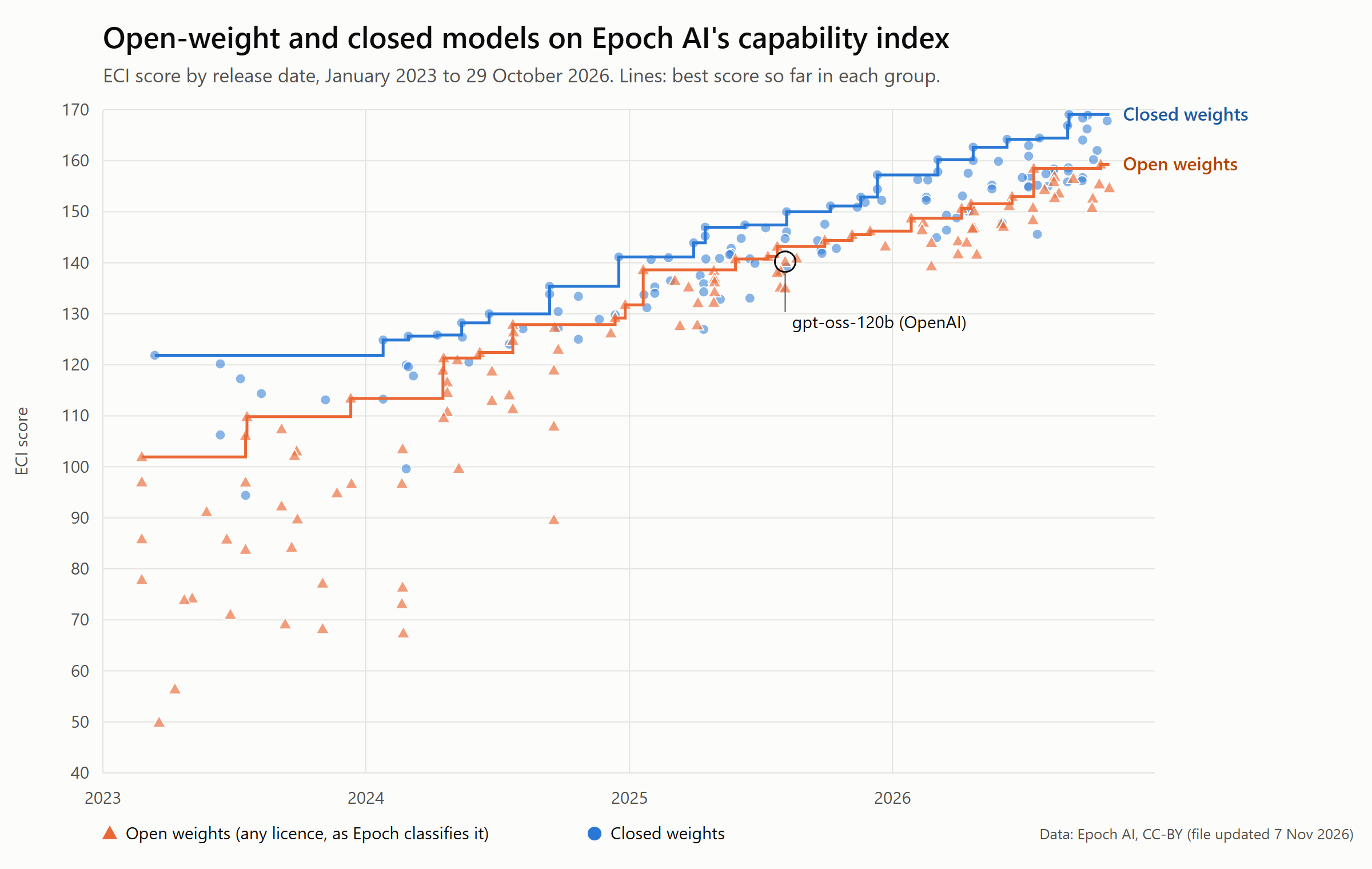
Each mark is one model in Epoch AI's data file, updated on 7 November 2026, released from January 2023 to 29 October 2026. Triangles are open weights and circles are closed weights, as Epoch groups them. The lines show the best score so far in each group. Models in Epoch's third group are left out. Data: Epoch AI, CC-BY [31, 32].
The chart marks one model named earlier, gpt-oss-120b. OpenAI says it comes close to its own o4-mini on reasoning benchmarks of OpenAI's choosing, while running on a single 80 GB GPU [15]. In Epoch's file, it scored about 5 points below o4-mini, and the two scores' uncertainty ranges do not overlap. Epoch's index is a different measure from those benchmarks [32].
In the same file, the five highest-scoring open-weight models all come from China-based organisations. Three are DeepSeek models, which Epoch labels open weights without restrictions. The other two are Moonshot's Kimi K3, labelled non-commercial, and Z.ai's GLM-5.3, labelled restricted use [32]. So, on Epoch's labels, even the leading open models come under different terms.
Next comes Artificial Analysis, which rebuilt its index on 27 October 2026. Now 60% of that index rests on private test sets or held-out answers. Its best open weights model, Kimi K3.1 Pro, was 12 points behind the leader on the new version. On the old version the gap was 3. Kimi K3.1 Pro's weights were unreleased at the time. Among models with released weights, the best two were 26 points behind the overall leader [20].
Epoch's own analysis is dated 29 May 2026. It put the average gap since January 2026 at 8 index points, which it called similar to the step from GPT-5 to GPT-5.5. It also measured the lag in time: the most capable open-weight models had trailed frontier closed models by four months on average. Epoch warned that the true gap may tend to be larger than its estimate. Evidence suggests open-weight models tend to do worse than closed ones on private benchmarks, plausibly because they are tuned harder to public ones. And the leading closed labs sometimes hold back their most capable models [33].
Our 10, from the November file, does not show a widening from Epoch's 8. On Epoch's May file, our calculation gives about 8 points, as Epoch reports. On the November file, the same January-to-May period gives about 10. The newer file holds a different set of models, with different scores [32].
The oldest reading is from Stanford's AI Index, in a key finding that also cites the Arena Leaderboard. In March 2026, the best closed model was 3.3% ahead of the best open one, against 0.5% in August 2024. The gap had briefly closed in 2024 and reopened in 2025. The Index adds a caution. Separate research suggests a model's Arena standing may partly show adaptation to that platform instead of general capability. Six makers share the top tier of those ratings: Anthropic, xAI, Google, OpenAI, Alibaba and DeepSeek [34].
These are general measures. None of the figures above is broken down by Indian language.
Where your data goes

Whether a model is open does not decide where your data goes. Where it runs is the first question: on your own servers, or on a provider's. The provider's policy and contract decide the rest. So ask any provider, open or closed, the same questions: what does it keep, for how long, and where?
In India, two rules also say what must be kept. CERT-In's Directions of 28 April 2022 name "service providers, intermediaries, data centres, body corporate and Government organisations". They must keep logs of their ICT systems for a rolling 180 days, within Indian jurisdiction [35]. The Digital Personal Data Protection Rules, 2025 add a duty for a Data Fiduciary, such as a company that holds customer records. For purposes the Rules specify, it must retain personal data, traffic data and other processing logs for at least one year. The duty covers processing done on its behalf. In the Rules' example, the company must ensure its cloud provider also keeps the data and associated logs. The Gazette with the Rules is dated 13 November 2025, and this duty comes into force eighteen months after publication [36].
Product settings matter too. Take Google's Gemini Apps Privacy Hub, last updated on 26 October 2026. With the Keep Activity setting on, it says, Google uses your activity to improve its services, including by training generative AI models. With the setting off, future chats are not used to train its models unless you send feedback [37]. Those terms cover the Gemini Apps. Check the terms of the API or business product you actually buy.
India's releases, November 2026
India's November releases show why the label, the licence and the download each need checking. On 3 November 2026, the Press Information Bureau announced three IndiaAI Mission models. It calls Soket's EKA-1 "Open" and ZenteiQ's Dhīr 2B and Dhīr 5B "Open-Source" [38].
AIKosh, the IndiaAI platform, lists all three under an Apache 2.0 licence. Each was marked Restricted on the day we read its page, 5 or 9 November. A restricted item, AIKosh's FAQ says, needs the contributor's explicit approval before download [39, 40, 41, 42, 43]. So the licence was permissive, but the download was marked as needing approval.
Sarvam AI's Sarvam-Prism has a Hugging Face repository, created on 2 November, that carries an Apache 2.0 licence. Sarvam also offers a hosted API. It is a decision model that does not generate text [44, 45].
Rhodium Group's report of 27 October 2026 adds context: nearly 80% of the IndiaAI Mission's GPUs reportedly sit unused. In Rhodium's view, India is also warming to Chinese open-weight models [46].
Five questions before you plan around an open model

- Which of the three kinds is it? Proprietary, open-weight under the maker's licence, or open source as OSI defines it. A press release or a maker's post may use the word open loosely, so read what is actually released [21, 23].
- What does the licence text allow for your use? Check use inside your company, in your product, and as a service you sell. Read the clause itself as well as the maker's summary [28, 27, 29].
- What has the maker actually released, and can you download it today? A maker can promise weights by a date, limit what it releases, or list a model that needs approval to download. Check the registry page, the licence file (a tag is not enough) and any access request or approval needed [18, 19, 44, 39, 42, 24].
- Where will the model run, and what must you keep? In India, check which of the two duties above applies to you, and from when [35, 36].
- Does it do your task, in your languages? The capability measures above are general and dated. Test the model on your own tasks and languages before you plan around it.
Why would anyone give this away for free?
Several makers in this story gave their own reasons. They leave two questions open: what an open model costs to run, and what a maker gains by giving one away. Part 2 of this series takes up those questions. Part 3 asks whether an open model is safe to use.
Where we fit
IndicStack is one OpenAI-compatible API for open-weight models such as DeepSeek, GLM, Qwen and Gemma, billed in INR, with models labelled India-hosted or Global. We delete your prompts, files and completions after responding, and keep request metadata for 12 months, for billing and security.
Disclaimer
This article is for information only. It is not legal, licensing, compliance or procurement advice, and it does not replace reading the licence and terms of any model you plan to use. It was drafted with the help of AI. IndicStack chose the sources, checked every figure and reference against its source, and reviewed the article before publication. Details are as at the date of publication and may change. Naming an organisation, model or product does not imply endorsement by, or affiliation with, IndicStack.
Copyright © IndicStack Consultancy Services LLP 2026
References
- OpenAI. OpenAI API. 11 June 2020. https://openai.com/blog/openai-api/ (read from the Internet Archive copy of 11 June 2020; accessed 5 November 2026).
- [1706.03762] Attention Is All You Need. arXiv (Vaswani et al., Attention Is All You Need). https://arxiv.org/abs/1706.03762 (accessed 5 November 2026).
- Open Sourcing BERT: State-of-the-Art Pre-training for Natural Language Processin. Google Research blog (open-sourcing BERT). https://research.google/blog/open-sourcing-bert-state-of-the-art-pre-training-for-natural-language-processing/ (accessed 5 November 2026).
- OpenAI. Better Language Models and Their Implications. 14 February 2019. https://openai.com/blog/better-language-models/ (read from the Internet Archive copy of 11 March 2019; accessed 5 November 2026).
- [2005.14165] Language Models are Few-Shot Learners. arXiv (Brown et al., Language Models are Few-Shot Learners, GPT-3). https://arxiv.org/abs/2005.14165 (accessed 5 November 2026).
- [2211.05100] BLOOM: A 176B-Parameter Open-Access Multilingual Language Model. arXiv (BigScience, BLOOM). https://arxiv.org/abs/2211.05100 (accessed 5 November 2026).
- OpenAI. ChatGPT: Optimizing Language Models for Dialogue. 30 November 2022. https://openai.com/blog/chatgpt/ (read from the Internet Archive copy of 2 December 2022; accessed 5 November 2026).
- OpenAI. GPT-4. 14 March 2023. https://openai.com/research/gpt-4 (read from the Internet Archive copy of 15 March 2023; accessed 5 November 2026).
- Introducing LLaMA: A foundational, 65-billion-parameter language model. Meta AI blog (Introducing LLaMA). https://ai.meta.com/blog/large-language-model-llama-meta-ai/ (accessed 5 November 2026).
- Meta and Microsoft Introduce the Next Generation of Llama. Meta AI blog (Llama 2 announcement). https://ai.meta.com/blog/llama-2/ (accessed 5 November 2026).
- Mistral 7B. Mistral AI (Mistral 7B announcement). https://mistral.ai/news/announcing-mistral-7b/ (accessed 5 November 2026).
- Open Source AI is the Path Forward. Meta (Mark Zuckerberg, essay). https://about.fb.com/news/2024/07/open-source-ai-is-the-path-forward/ (accessed 5 November 2026).
- Gemma releases | Google AI for Developers. Google AI for Developers (Gemma releases page, English). https://ai.google.dev/gemma/docs/releases?hl=en (accessed 5 November 2026).
- Gemma 4 model card | Google AI for Developers. Google AI for Developers (Gemma 4 model card). https://ai.google.dev/gemma/docs/core/model_card_4?hl=en (accessed 5 November 2026).
- OpenAI. Introducing gpt-oss | OpenAI. 5 August 2025. https://openai.com/index/introducing-gpt-oss/ (read from the Internet Archive copy of 6 August 2025; accessed 5 November 2026).
- openai/gpt-oss-120b, Hugging Face model record. Hugging Face API (openai/gpt-oss-120b, model record). https://huggingface.co/api/models/openai/gpt-oss-120b (accessed 5 November 2026).
- openai/gpt-oss-20b, Hugging Face model record. Hugging Face API (openai/gpt-oss-20b, model record). https://huggingface.co/api/models/openai/gpt-oss-20b (accessed 5 November 2026).
- Kimi K3.1 Pro Tech Blog: Advancing Open Intelligence. Moonshot AI (Kimi blog). https://www.kimi.ai/blog/kimi-k3-1-pro (accessed 5 November 2026).
- moonshotai/Kimi-K3.1-Pro, Hugging Face model record. Hugging Face API (moonshotai/Kimi-K3.1-Pro, file list). https://huggingface.co/api/models/moonshotai/Kimi-K3.1-Pro (accessed 5 November 2026).
- Announcing Artificial Analysis Intelligence Index v5 | Artificial Analysis. Artificial Analysis, article announcing Intelligence Index v5. https://artificialanalysis.ai/articles/artificial-analysis-intelligence-index-v5 (accessed 7 November 2026).
- The Open Source AI Definition - 1.0 - Open Source Initiative. Open Source Initiative (Open Source AI Definition). https://opensource.org/ai/open-source-ai-definition (accessed 5 November 2026).
- OSAID FAQs - Open Source Initiative. Open Source Initiative (OSAID FAQs). https://opensource.org/ai/faq (accessed 5 November 2026).
- [2403.13784] The Model Openness Framework: Promoting Completeness and Openness for Reproducibility, Transparency, and Usability in Artificial Intelligence. arXiv (Model Openness Framework), abstract page. https://arxiv.org/abs/2403.13784 (accessed 5 November 2026).
- [2602.08816] Permissive-Washing in the Open AI Supply Chain: A Large-Scale Audit of License Integrity. arXiv (Permissive-Washing in the Open AI Supply Chain), abstract page. https://arxiv.org/abs/2602.08816 (accessed 5 November 2026).
- Apache License, Version 2.0. Apache Software Foundation (Apache License 2.0). https://www.apache.org/licenses/LICENSE-2.0.txt (accessed 5 November 2026).
- Gemma Terms of Use | Google AI for Developers. Google (Gemma Terms of Use). https://ai.google.dev/gemma/terms (accessed 5 November 2026).
- Mistral Large 4 (Le Chonk) is now open weight | Mistral. Mistral AI (news). https://mistral.ai/news/mistral-large-4-oss/ (accessed 5 November 2026).
- Mistral Ecosystem Open-Weight License. Mistral AI (licence file on Hugging Face). https://huggingface.co/mistralai/Mistral-Large-4-1T-A52B/raw/main/LICENSE (accessed 5 November 2026).
- Llama 4 Community License Agreement. Meta (Llama 4 Community License Agreement). https://dev.meta.ai/llama/llama4/license (accessed 5 November 2026).
- Chip Huyen. AI Engineering: Building Applications with Foundation Models. O'Reilly Media, 2025. ISBN 978-1-098-16630-4.
- Epoch Capabilities Index | Epoch AI. Epoch AI, Epoch Capabilities Index hub page (downloads and licence). https://epoch.ai/eci (accessed 7 November 2026).
- Epoch Capabilities Index model scores (data file). Epoch AI, Epoch Capabilities Index model scores (data file, CC-BY; hub says "Updated Nov. 7, 2026"). https://epoch.ai/data/eci_scores.csv (accessed 7 November 2026).
- Open models lag state-of-the-art closed models by 4 months | Epoch AI. Epoch AI, data insight: open models lag closed models (Epoch Capabilities Index). https://epoch.ai/data-insights/open-closed-eci-gap (accessed 5 November 2026).
- Technical Performance | The 2026 AI Index Report | Stanford HAI. Stanford HAI, AI Index Report 2026, Technical Performance chapter page. https://hai.stanford.edu/ai-index/2026-ai-index-report/technical-performance (accessed 5 November 2026).
- Directions under sub-section (6) of section 70B of the Information Technology Act, 2000. Indian Computer Emergency Response Team (CERT-In), MeitY. https://www.cert-in.org.in/PDF/CERT-In_Directions_70B_28.04.2022.pdf (accessed 5 November 2026).
- Digital Personal Data Protection Rules, 2025. MeitY, Gazette of India, G.S.R. 846(E), 13 November 2025. https://egazette.gov.in/WriteReadData/2025/267650.pdf (accessed 6 October 2026).
- Gemini Apps Privacy Hub - Gemini Apps Help. Google (Gemini Apps Privacy Hub). https://support.google.com/gemini/answer/13594961?hl=en (accessed 5 November 2026).
- Press Release Page | Press Information Bureau. Press Information Bureau (Government of India), MeitY release. https://www.pib.gov.in/PressReleasePage.aspx?PRID=2332315®=48&lang=1 (accessed 5 November 2026).
- AIKosh, ZenteiQ organisation profile, models tab. AIKosh (IndiaAI, Government of India), ZenteiQ organisation profile, models tab; rendered DOM saved by headless Edge. https://aikosh.indiaai.gov.in/home/public-profile/org/565d8def-78ab-4209-acdb-aa1d5198321a?tabs=models (accessed 5 November 2026).
- Dhir-2B, AIKosh model page. AIKosh (IndiaAI, Government of India), Dhir-2B model page; rendered DOM saved by headless Edge. https://aikosh.indiaai.gov.in/home/models/details/dhir_2b.html (accessed 5 November 2026).
- Dhir-5B, AIKosh model page. AIKosh (IndiaAI, Government of India), Dhir-5B model page; rendered DOM saved by headless Edge. https://aikosh.indiaai.gov.in/home/models/details/dhir_5b_1.html (accessed 5 November 2026).
- AIKosh Frequently Asked Questions. AIKosh (IndiaAI, Government of India), Frequently Asked Questions; rendered DOM saved by headless Edge. https://aikosh.indiaai.gov.in/home/faqs (accessed 5 November 2026).
- EKA-1-26B, AIKosh model page. AIKosh (IndiaAI, Government of India), EKA-1-26B model page; rendered DOM saved by headless Edge. https://aikosh.indiaai.gov.in/home/models/details/eka_1_26b_1.html (accessed 9 November 2026).
- sarvamai/prism, Hugging Face model record. Hugging Face API (Sarvam AI, model metadata). https://huggingface.co/api/models/sarvamai/prism (accessed 5 November 2026).
- Sarvam-Prism. Sarvam AI (model card README on Hugging Face). https://huggingface.co/sarvamai/prism/raw/main/README.md (accessed 5 November 2026).
- Hyperscaler Heaven? A Reality Check on India's AI Ambition and Geopolitical Alignment. Rhodium Group (A. Tiwari, R. Goujon). https://rhg.com/wp-content/uploads/2026/10/Hyperscaler-Heaven-A-Reality-Check-on-Indias-AI-Ambition-and-Geopolitical-Alignment.pdf (accessed 5 November 2026).
Related reading

Before You Serve a Quantised LLM, Run This Short Check
A model file can load, answer at normal speed, and still fail the job you need it for. Here is what one audit found, and a check to run before you serve a build.
Read the article →
Before You Buy AI Compute, Ask These Five Questions
At AWS, the biggest blocks of committed cloud capacity are now booked years ahead. Twenty years of GPU history show where else extra capacity can come from.
Read the article →