Free to Download: Who Pays to Run It?
An open model is free to download, but someone pays to run it, and how much depends on your workload. This article sets out the patterns behind three ways to pay for running a model, and ends with a way to choose between them.

Jump to section
- Three ways to pay for a free model
- Is running AI getting cheaper or dearer?
- What each option charges for, and what it leaves out
- When do your own GPUs pay off?
- What changes in India?
- Which option should you choose?
- Is it safe?
- Where we fit
- References
Three ways to pay for a free model
An open release moves the cost of running a model from the maker to whoever runs it. This series began with Part 1, which ended with the makers' own reasons for opening their models. OpenAI once chose an API partly because its large models were expensive to run [1].
Some makers offer the same model both ways. Sarvam AI publishes Sarvam-Prism for download and also offers it as a hosted API [2]. Licences can also set terms for the largest users. Meta's Llama 4 licence sets a condition for companies whose products had more than 700 million monthly active users "in the preceding calendar month". Such a company must request a licence, which Meta may grant at its discretion [3].
A team weighing an open model has three broad options. It can rent or buy GPUs and run the model itself, or pay a host that serves the same open weights through an API. Or it can choose a proprietary model through its maker's API instead.
A few terms help. A token is a small piece of text, about a word or part of a word; APIs charge per million tokens. A GPU-hour is one graphics processor rented for an hour. On demand means renting by the hour with no commitment; reserved means committing for a period at a lower rate. Time to first token is the wait before an answer starts to arrive.
For your choice: the download is the free part. The real question is which way of paying for the running suits your work.
Is running AI getting cheaper or dearer?
It depends on what you run. The same level of ability has been getting cheaper quickly, while running the newest models can cost more.
Epoch AI reported in September 2026 on the price of reaching a given level of AI performance. It had fallen by a factor of about 13 a year since 2023. The fall was fastest just after the best models first reached a level, and half as fast two years on [4]. A March 2026 preprint from MIT FutureTech, with price data to November 2025, also found fast falls for a fixed level of performance. It found too that the price of running the most capable models was rising, as models grow and reason at greater length [5].
Some list prices are going up as well. Google, for example, is raising the input price of Gemini 4 Argon from 1 December 2026 [6]. Renting GPUs became dearer in 2026 at two providers that sell GPU rental. The chart shows the on-demand price of an NVIDIA H100 at Lambda and Nebius, from their own price pages and archived copies of them [7, 8, 9, 10, 11, 12, 13, 14, 15, 16].
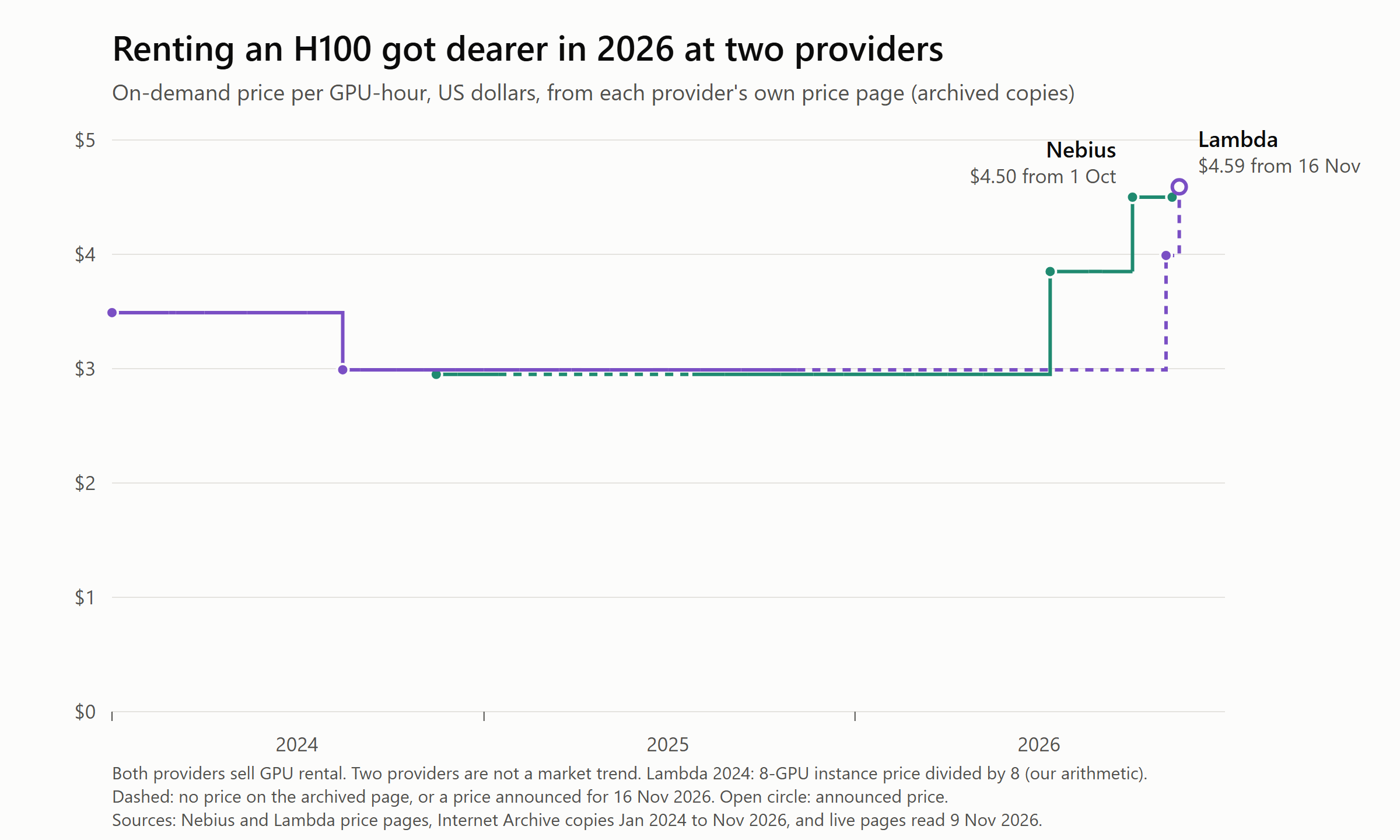
For your choice: it may help to ask what level of ability your task really needs. If a model at last year's level handles your task well, the price of that level of performance has fallen fast.
What each option charges for, and what it leaves out
APIs charge per million tokens, so you pay for what you use. GPUs charge by the hour, whether they are busy or idle. To compare the two, one published study measured API costs against the tokens the hardware can produce [17].
A proprietary API keeps a quiet month cheap, but the price and the model can change on the maker's timetable. OpenAI gives at least six months' notice before it retires a generally available model, except where safety or compliance needs a shorter timeline. It shut its o4-mini model down on 23 October 2026 [18]. Anthropic gives at least 60 days' notice for a publicly released model; once a model is retired, requests to it fail [19]. From 1 December 2026, Google will route requests for gemini-2.5-pro to gemini-3.8-flash, billed at that model's rates [20]. A 2024 study of the March and June 2023 versions of GPT-4 found that the same service behaved differently within months [21].
A host that serves open weights also charges per token, for a model anyone can download. OpenAI said its open-weight gpt-oss-120b nearly matched o4-mini on core reasoning benchmarks that it chose [22]. Epoch AI's capability index scores o4-mini higher, and the ranges around the two scores do not overlap [23]. On 9 November 2026, Together AI listed gpt-oss-120b at $0.15 per million input tokens and $0.60 per million output tokens [24]. OpenAI's own o4-mini page had listed $1.10 and $4.40 on 1 October 2026 [25].
Hosts change their models too. Groq retires older models in favour of newer ones and may upgrade some automatically [26]. On its serverless endpoints, Together AI gives two or three weeks' notice, or three days' notice before it redirects to a strongly compatible upgrade. The old version may stay available on a dedicated endpoint, where the model supports one. It suggests testing a replacement first, as replacements rarely behave in quite the same way [27]. Speed also varies: Artificial Analysis lists 16 endpoints for gpt-oss-120b, each performing differently, and a provider's performance can change over time [28].
Your own or rented GPUs are paid for even when idle. Parity Technologies reported that its rented GPUs were idle 55% of the time in their first month. Its own post adds that its GPU figure "excludes engineering time, which is easily the higher cost" [29]. In a university chatbot study, demand rose and fell with the academic year, which would have left much of a dedicated machine idle [30].
Requests to your own GPUs can also wait in a queue. Parity reported an average of 3.34 seconds to the first token, and an average queue time of 2.25 seconds [29].
In return, you control the version. Hugging Face's download tools can fetch a model at one fixed version [31]. OpenAI released gpt-oss under the Apache 2.0 licence, which grants a perpetual, irrevocable licence [22, 32].
For your choice: it helps to measure how much work a GPU does in an hour on your own workload, at your expected load.
When do your own GPUs pay off?
The two published studies we found count different things, so their answers cannot be set side by side as one number.
- Pan and others, IEEE BigData 2025, counted hardware and electricity for 8 hours a day at 2025 prices. They found self-hosting viable mainly at 50 million tokens a month or more, or where strict data residency rules apply. For small businesses under 10 million tokens a month, small models could pay back within months against some APIs. Against aggressively priced APIs, large models could take years.
- Tombor and Abonyi, IEEE Access, August 2026, studied a university chatbot with seasonal demand. Under the study's own cost estimates, an API was far cheaper; self-hosting became plausible only at hundreds of thousands of sessions a month.
These entries rest on the studies' own texts [17, 33, 30]. The first study compares API costs with what the hardware can produce in its working hours. On our reading of that method, a team that uses less of that output would break even later. The study also leaves out staffing and maintenance [17].
Parity reported a self-hosting trial: about 12.9 billion tokens through rented GPUs in a month, for 25 engineers [29]. Revolut described 56 B200 GPUs serving roughly 2,000 engineers. The conference site notes that its figures are not a portable price for other self-hosted models [34].
What changes in India?
India adds an official route for approved users. The IndiaAI portal's list of empanelled GPUs names 13 bidders. Among them are E2E Networks, Yotta, Jio Platforms, Cyfuture, Sify and a consortium of NTT and Neysa [35].
The portal's price calculator, read on 16 November 2026, lists one H100 SXM GPU at ₹153.0 an hour on demand, and less when reserved. Its prices exclude GST and other taxes, and it shows the subsidy separately: "Max upto 40% subject to approval from IndiaAI" [36]. The end-user policy, in a file from February 2025, says a committee decides each subsidy. It names those IndiaAI intends to serve: "academia, MSMEs, startups, research community, governments, public sector agencies and other entities registered and approved by IndiaAI" [37]. A portal page read on 9 November 2026 says a compute request for fewer than 5000 GPU hours is approved automatically [38]. In December 2025 the government's press bureau gave a subsidised rate of ₹65 an hour, without naming the GPU [39].
Providers list their H100 offers in different units and currencies, and not all of them state GST. Here are the hourly H100 list prices of four of them, read on 16 November 2026:
| Provider | Listed price | Unit | GST |
|---|---|---|---|
| E2E Networks | from ₹379.05 an hour | one H100, on demand | its rate card says prices exclude 18% GST |
| Yotta | ₹596 an hour | a virtual machine with one H100 SXM, on demand | not stated on the page |
| Cyfuture | from $3.66 an hour | one H100 SXM, on demand | not stated on the page |
| Neysa | from $4.39 an hour | one H100 SXM | not stated on the page |
Each row comes from the provider's own page [40, 41, 42, 43, 44].
Distance can add delay too. Microsoft's page of 30 July 2026 gives median round trips between its own cloud regions. From Central India, it gives 201 milliseconds to US East and 20 milliseconds to South India [45]. These are round trips between Microsoft's own regions; they do not measure the time a user waits for an answer. Still, a 2025 workshop paper notes that services hosted far from their users can give a worse experience through added latency [46].
For your choice: a written quote that names the GPU, the unit and the GST makes providers easier to compare.
Which option should you choose?
There is no single answer, but the points above suggest an order of checks.
- Test the open model on your own task first. If its answers are not good enough, its price matters less.
- If your demand rises and falls, or nobody on your team can run GPUs, an API is a sensible start. It can be a proprietary API or a host that serves the open model [30, 29].
- If your product must behave the same way for a long time, plan for model changes. Makers and hosts retire models on their own notice periods, while weights you run yourself can stay on one version [18, 19, 27, 31].
- If response time matters, measure it from where your users are, at your expected load [28, 45, 29].
- Consider your own or rented GPUs when your use is high and steady enough to keep them busy. Rules on data or version control may also call for them. Either way, count the people needed to run them [17, 30, 31, 29].
- In India, if you are eligible, consider applying to IndiaAI before renting at a list price [36, 37].
- Whichever you choose, date every quote and check it again before you sign. Prices moved both ways in 2026 [4, 6, 16].
Is it safe?
Parity ran DeepSeek V4 Flash, and Revolut ran GLM 5.3. Epoch AI's model file lists both as open models made in China [29, 34, 23]. Is it safe to use an open model, from China or anywhere else? That is the question for Part 3 of this series. It covers what an open model can do with your data, how the models have been tested, and what Indian rules say.
Where we fit
IndicStack is one OpenAI-compatible API for many models, including India-hosted open models, billed in rupees with GST invoices. For the checks above:
- Test on your own task (step 1): you can run your workload on open and proprietary models through one key. IndicStack can also show which of your calls can run on a lower-cost model.
- Demand rises and falls (step 2): you can pay as you go, per token.
- Model changes (step 3): through one key you can call many models, so you can test another model before you switch.
- Response time (step 4): you can send the same requests to several models and compare them. Each model is labelled India-hosted or Global, so you can check where it runs.
- Your own GPUs (step 5): IndicStack's team also offers dedicated GPU deployments in India.
- In India (step 6): separately from IndiaAI, IndicStack's India-hosted models run on GPUs in Indian data centres. Prompts and completions on them are never used to train models.
Disclaimer
This article is for information only. It is not financial, procurement or investment advice, and it does not replace quotes and terms from the providers you plan to use. Prices and terms are as read on the dates given and may change. Figures that companies publish about their own products are their own and were not checked independently. IndicStack sells inference and GPU capacity in India and competes with some of the companies named. The table of Indian prices covers only four of the providers on the IndiaAI portal's list. The article was drafted with the help of AI. IndicStack chose the sources, checked every figure and reference against its source, and reviewed the article before publication. Naming an organisation, model or product does not imply endorsement by, or affiliation with, IndicStack.
Copyright © IndicStack Consultancy Services LLP 2026
References
- OpenAI API. OpenAI, 'OpenAI API' (Internet Archive copy of 11 Jun 2020; live page 403 to scripts). https://web.archive.org/web/20200611200915id_/https://openai.com/blog/openai-api/ (accessed 5 November 2026).
- Sarvam-Prism. Sarvam AI (model card README on Hugging Face). https://huggingface.co/sarvamai/prism/raw/main/README.md (accessed 5 November 2026).
- Llama 4 Community License Agreement. Meta (Llama 4 Community License Agreement). https://dev.meta.ai/llama/llama4/license (accessed 5 November 2026).
- The plunging price of thought | Epoch AI. Epoch AI, report: 'The plunging price of thought'. https://epoch.ai/publications/the-plunging-price-of-thought (accessed 9 November 2026).
- [2511.23455] The Price of Progress: Price Performance and the Future of AI. arXiv (Gundlach, Lynch, Mertens, Thompson; The Price of Progress: Price Performance and the Future of AI), abstract page; preprint. https://arxiv.org/abs/2511.23455 (accessed 9 November 2026).
- Gemini Developer API pricing. Google AI for Developers (Gemini Developer API pricing); rendered DOM saved by headless Edge. https://ai.google.dev/gemini-api/docs/pricing (accessed 9 November 2026).
- Rent NVIDIA GPUs on demand: H100, H200, and B200 | Lambda. Lambda (GPU cloud provider, on-demand instances page with prices that take effect 16 Nov 2026); vendor (sells GPU rental). https://lambda.com/instances (accessed 9 November 2026).
- GPU Cloud - VMs for Deep Learning | Lambda. Lambda (GPU cloud provider, own price page), Internet Archive copy of 2024-01-01; vendor (sells GPU rental). https://web.archive.org/web/20240101073433id_/https://lambdalabs.com/service/gpu-cloud (accessed 9 November 2026).
- GPU Cloud - VMs for Deep Learning | Lambda. Lambda (GPU cloud provider, own price page), Internet Archive copy of 2024-08-15; vendor (sells GPU rental). https://web.archive.org/web/20240815145430id_/https://lambdalabs.com/service/gpu-cloud (accessed 9 November 2026).
- On-Demand GPU Cloud | Lambda. Lambda (GPU cloud provider, own price page), Internet Archive copy of 2025-11-05; vendor (sells GPU rental). https://web.archive.org/web/20251105171343id_/https://lambda.ai/service/gpu-cloud (accessed 9 November 2026).
- Rent NVIDIA GPUs on demand: H100, H200, and B200 | Lambda. Lambda (GPU cloud provider, own price page), Internet Archive copy of 2026-11-03; vendor (sells GPU rental). https://web.archive.org/web/20261103005910id_/https://lambda.ai/instances (accessed 9 November 2026).
- GPU Cloud pricing. Nebius (GPU cloud provider, own price page), Internet Archive copy of 2024-11-15; vendor (sells GPU rental). https://web.archive.org/web/20241115043809id_/https://nebius.com/prices (accessed 9 November 2026).
- NVIDIA GPU Pricing | Nebius AI Cloud. Nebius (GPU cloud provider, own price page), Internet Archive copy of 2026-05-07; vendor (sells GPU rental). https://web.archive.org/web/20260507111158id_/https://nebius.com/prices (accessed 9 November 2026).
- NVIDIA GPU Pricing | Nebius AI Cloud. Nebius (GPU cloud provider, own price page), Internet Archive copy of 2026-07-12; vendor (sells GPU rental). https://web.archive.org/web/20260712235400id_/https://nebius.com/prices (accessed 9 November 2026).
- NVIDIA GPU Pricing | Nebius AI Cloud. Nebius (GPU cloud provider, own price page), Internet Archive copy of 2026-10-01; vendor (sells GPU rental). https://web.archive.org/web/20261001030509id_/https://nebius.com/prices (accessed 9 November 2026).
- NVIDIA GPU Pricing | Nebius AI Cloud. Nebius (GPU cloud provider, price page); vendor (sells GPU rental). https://nebius.com/prices (accessed 9 November 2026).
- A Cost-Benefit Analysis of On-Premise Large Language Model Deployment: Breaking Even with Commercial LLM Services. arXiv (Pan, Chodnekar, Roy, Wang; cost-benefit analysis of on-premise LLM deployment, break-even), full text v3. https://arxiv.org/html/2509.18101v3 (accessed 9 November 2026).
- Deprecations | OpenAI API. OpenAI (API deprecations page). https://developers.openai.com/api/docs/deprecations (accessed 5 November 2026).
- Model deprecations. Anthropic, Claude Platform Docs; vendor (sells model access through an API). https://platform.claude.com/docs/en/about-claude/model-deprecations (accessed 16 November 2026).
- Gemini deprecations. Google, Gemini API docs (rendered DOM saved by headless Edge, 16 Nov 2026); vendor (sells model access through an API). https://aistudio.google.com/docs/deprecations (accessed 16 November 2026).
- How Is ChatGPT’s Behavior Changing Over Time?. Harvard Data Science Review (Chen, Zaharia and Zou), DOI 10.1162/99608f92.5317da47. https://hdsr.mitpress.mit.edu/pub/y95zitmz (accessed 16 November 2026).
- Introducing gpt-oss | OpenAI. OpenAI, 'Introducing gpt-oss' (Internet Archive copy; the live openai.com page returns 403 to scripts). https://web.archive.org/web/20250807015938id_/https://openai.com/index/introducing-gpt-oss/ (accessed 5 November 2026).
- Epoch Capabilities Index model scores (data file). Epoch AI, Epoch Capabilities Index model scores (data file, CC-BY; hub says "Updated Nov. 7, 2026"). https://epoch.ai/data/eci_scores.csv (accessed 7 November 2026).
- Pricing | Together AI. Together AI (host of open-weight models, price page); vendor (sells inference). https://www.together.ai/pricing (accessed 9 November 2026).
- o4-mini Model | OpenAI API. OpenAI (o4-mini model page), Internet Archive copy of 2026-10-01; rendered DOM saved by headless Edge. https://web.archive.org/web/20261001000101/https://developers.openai.com/api/docs/models/o4-mini (accessed 10 November 2026).
- Model Deprecation. Groq, GroqDocs; vendor (sells inference, including open-weight models). https://console.groq.com/docs/deprecations (accessed 16 November 2026).
- Deprecations. Together AI docs; vendor (sells inference, including open-weight models). https://docs.together.ai/docs/deprecations (accessed 16 November 2026).
- gpt-oss-120b: API Provider Performance Benchmarking & Price Analysis. Artificial Analysis. https://artificialanalysis.ai/models/gpt-oss-120b/providers (accessed 16 November 2026).
- Testing Self-Hosted AI for Software Engineering: What Parity Learned from 13 Billion Tokens | Parity Technologies. Parity Technologies (company blog, Karim Jedda), 'Testing Self-Hosted AI for Software Engineering: What Parity Learned from 13 Billion Tokens'. https://www.parity.io/blog/self-hosted-ai-software-engineering (accessed 9 November 2026).
- Activity-Based Costing Framework for Total Cost of Ownership Analysis of LLM Services. IEEE Access (Tombor and Abonyi, Activity-Based Costing Framework for Total Cost of Ownership Analysis of LLM Services), full text PDF; peer-reviewed journal. https://ieeexplore.ieee.org/ielx8/6287639/11323511/11664064.pdf?arnumber=11664064 (accessed 9 November 2026).
- Download files from the Hub. Hugging Face, huggingface_hub documentation. https://huggingface.co/docs/huggingface_hub/guides/download (accessed 16 November 2026).
- Apache License, Version 2.0. Apache Software Foundation (Apache License 2.0). https://www.apache.org/licenses/LICENSE-2.0.txt (accessed 5 November 2026).
- A Cost-Benefit Analysis of On-Premise Large Language Model Deployment: Breaking Even with Commercial LLM Services. Crossref metadata (Pan, Chodnekar, Roy, Wang; IEEE BigData 2025 proceedings record); metadata only, venue and affiliations. https://api.crossref.org/works/10.1109/bigdata66926.2025.11400957 (accessed 9 November 2026).
- Shipping like a startup, regulated like a bank | AI Engineer NYC 2026. AI Engineer NYC 2026 (conference site), talk page with transcript: David Abitbol (Revolut), 'Shipping like a startup, regulated like a bank'. https://ai.engineer/nyc/2026/talks/revolut (accessed 9 November 2026).
- Empanelled GPUs. IndiaAI (MeitY), IndiaAI Compute Portal, list of empanelled GPUs by bidder (PDF linked from the portal home page as "Empanelled GPUs"). https://compute.indiaai.gov.in/files/empanelled-gpus.pdf (accessed 16 November 2026).
- India Al Cloud Computing Portal. IndiaAI (MeitY), IndiaAI Compute Portal price calculator (rendered DOM saved by headless Edge, 16 Nov 2026). https://compute.indiaai.gov.in/indiaaipricecalculator (accessed 16 November 2026).
- End User Policy. IndiaAI (MeitY), IndiaAI Compute Portal, end-user policy (PDF shown on the portal's End User Policy page). https://compute.indiaai.gov.in/files/end-user-policy.pdf (accessed 16 November 2026).
- India Al Cloud Computing Portal. IndiaAI (MeitY), IndiaAI cloud computing portal (eligibility and approval rules). https://compute.indiaai.gov.in/login (accessed 9 November 2026).
- Press Release Page | Press Information Bureau. Press Information Bureau (Government of India), 'Transforming India with AI' backgrounder (IndiaAI Compute Pillar, subsidised GPU rate). https://www.pib.gov.in/PressReleasePage.aspx?PRID=2209737®=3&lang=1 (accessed 9 November 2026).
- NVIDIA H100 GPU Price in India | Rent H100 80GB | From ₹379.05/hr | E2E Networks. E2E Networks, NVIDIA H100 product and price page (rendered DOM saved by headless Edge, 16 Nov 2026); vendor (sells GPU capacity in India; competes with IndicStack). https://www.e2enetworks.com/gpus/nvidia-h100 (accessed 16 November 2026).
- GPU Cloud Pricing | H200/H100 Starting ₹30/hr | E2E Networks. E2E Networks, rate card in Markdown served by the site (plain fetch, 16 Nov 2026); vendor (sells GPU capacity in India; competes with IndicStack). https://www.e2enetworks.com/pricing.md (accessed 16 November 2026).
- Yotta Shakti Cloud | Explore on Plans & Pricing. Yotta Data Services, Shakti Cloud price page (rendered DOM saved by headless Edge, 16 Nov 2026); vendor (sells GPU capacity in India; competes with IndicStack). https://shakticloud.ai/pricing (accessed 16 November 2026).
- GPU Cloud Pricing | H100, A100, L40S, V100 from $0.60/hr - Cyfuture AI. Cyfuture India, Cyfuture AI GPU price page (rendered DOM saved by headless Edge, 16 Nov 2026); vendor (sells GPU capacity in India; competes with IndicStack). https://cyfuture.ai/pricing (accessed 16 November 2026).
- AI Cloud Pricing - Neysa Velocis. Neysa Networks, Neysa Velocis price page (rendered DOM saved by headless Edge, 16 Nov 2026); vendor (sells inference or GPU capacity in India; competes with IndicStack). https://neysa.ai/pricing (accessed 16 November 2026).
- Azure network round-trip latency statistics. Microsoft Learn; vendor (sells cloud and GPU capacity, including Indian regions). https://learn.microsoft.com/en-us/azure/networking/azure-network-latency (accessed 16 November 2026).
- Edge-First Language Model Inference: Models, Metrics, and Tradeoffs. arXiv (Jang and Morabito, EURECOM), full text v2; published in IEEE ICDCS Workshops 2025, DOI 10.1109/ICDCSW63273.2025.00058. https://arxiv.org/html/2505.16508v2 (accessed 16 November 2026).
Related reading

AI in Tuberculosis Screening: A Flag Is Not a Diagnosis
The steps around the AI read: screening, local cutoffs, confirmatory tests and follow-up. By Dr Prasanth Ghanta, PhD.
Get the report →
What Are Open-Source AI Models and How Did They Come to Be?
Many AI models are now called open, but the word does not mean one thing. This article explains what each label lets you do, how open and closed models compare, and five questions to ask before you build on one.
Read the article →